9 Best Hose Reel Carts (October 2026)
The best hose reel carts include the WERMAH 300 Ft 4-Wheel Cart for large yards, the VEVOR 250 Ft Hose Reel Cart for moving between beds, and the Real Hose Stor 250 Ft Cart for everyday garden watering.
On this page (9 sections)
- How we chose the best hose reel carts
- The best hose reel carts by use
- What should you check before buying a hose reel cart?
- How much hose should you load onto a cart?
- How do you set up and load a hose reel cart?
- How do you keep a cart easy to use?
- Which mistakes make a hose reel cart harder to use?
- Is a hose reel cart better than a hose reel box?
- Which best hose reel cart fits your routine?
The best hose reel cart for most large yards is the WERMAH 300 Ft 4-Wheel Cart, with room for a long hose, a wide base and an included leader hose. Choose a guided Giraffe Tools cart if spreading the hose evenly during rewind matters more than maximum capacity.
The right cart should fit your hose, your watering route and the place where you park it. A large reel saves little effort if you must lift it over steps each time you water.
For other storage layouts, compare the main hose reel types and hose reel cart vs hose reel box.
Our picks at a glance
-
1

-
2

-
3

- 4
 Check it
Giraffe Tools 200 Ft Hose Cart
Best for smaller watering routes - 5
 Best for long watering routesCheck it
- 6
 Check it
Giraffe Tools 250 Ft Hose Cart
Best for frequent hose winding - 7
 Best for parking between tasksCheck it
- 8
 Check it
VEVOR 200/300 Ft High-Pressure Cart
Best for assisted manual winding - 9
 Best for avoiding cart assemblyCheck it
How we chose the best hose reel carts
We compared hose fit, wheel layout and winding features to find carts for different yard routines. We also considered included leader hoses, storage space and assembly needs.
Capacity matters most when you already have a long hose, while a guide becomes more useful when you rewind often. Empty weight helps compare carts, but the hose and any trapped water add to the load you move.
All these picks use manual operation. A guide or gear drive can change how you wind, but neither means the reel pulls the hose back automatically.
| Product | Best for | Capacity | Wheels | Leader hose | Our score |
|---|---|---|---|---|---|
| WERMAH 300 Ft 4-Wheel Cart | large yards | 300 ft of 5/8 in hose | 4 airless tires | 6.5 ft | 8.2 |
| VEVOR 250 Ft Hose Reel Cart | moving between beds | 250 ft of 5/8 in hose | 4 solid PU wheels | 7.9 | |
| Real Hose Stor 250 Ft Cart | everyday garden watering | 250 ft of 5/8 in hose | 6 ft | 7.8 | |
| Giraffe Tools 200 Ft Hose Cart | smaller watering routes | 200 ft of 1/2 in hose or 150 ft of 5/8 in hose | 2 solid tires | 7.7 | |
| VEVOR 300 Ft Hose Reel Cart | long watering routes | 300 ft of 5/8 in hose | 7.6 | ||
| Giraffe Tools 250 Ft Hose Cart | frequent hose winding | 250 ft of 5/8 in hose | 4 wheels | 7.5 | |
| WERMAH 230 Ft 2-Wheel Cart | parking between tasks | 230 ft of 5/8 in hose | 2 airless tires | 6.5 ft | 7.1 |
| VEVOR 200/300 Ft High-Pressure Cart | assisted manual winding | 200 ft of 5/8 in or 300 ft of 1/2 in hose | 2 | 6.9 | |
| Hosemobile 175 Ft Hose Cart | avoiding cart assembly | 175 ft of 5/8 in hose | 6.7 |
The best hose reel carts by use
The WERMAH leads for large-yard storage, while the other picks suit different routes, winding habits and setup preferences. Read the tradeoffs below before choosing the highest-capacity option.
1. WERMAH 300 Ft 4-Wheel Cart
WERMAH 300 Ft 4-Wheel Cart
- Holds 300 ft of 5/8 in hose
- Four wheels
- 6.5 ft leader hose
- Storage basket
A wide base and long-hose capacity suit large yards with several watering areas. An angled brass connector helps keep the first bend into the reel open.
Pros
- Joint-largest 5/8 in capacity here
- Includes leader hose and basket
- Airless tires need no inflation
Cons
- Main hose not included
- No brake
Choose this WERMAH for a large yard where you need up to 300 ft of 5/8 in hose on one reel. Its wide base makes it a sensible starting point for buyers who want a four-wheel cart rather than a frame they must tilt.
The angled brass connector is a useful detail at the hose entry point. WERMAH designed it to reduce sharp bending near the reel, though you still need to remove twists farther along the hose before winding.
A 6.5 ft leader hose gives you a connection to the faucet, and the basket can hold a nozzle or small watering tools. Keep the leader slack enough that moving the cart a little does not pull on the faucet.
Skip it for sloping parking areas, since there is no brake. It is also more cart than you need for a short patio hose, especially if you must carry the reel into storage.
2. VEVOR 250 Ft Hose Reel Cart
VEVOR 250 Ft Hose Reel Cart
- Holds 250 ft of 5/8 in hose
- Four solid 10 in PU wheels
- Low center of gravity
- Storage basket
This four-wheel cart suits gardeners who move their reel between watering spots. Its empty weight is lower than the top pick's, and a basket keeps small accessories together.
Pros
- Solid tires need no inflation
- Low-center frame
- Includes a storage basket
Cons
- Main hose not included
- Less capacity than the 300 ft carts
The VEVOR suits gardeners who roll between several watering areas and do not need the largest reel here. Its four solid 10 in PU wheels need no inflation, which removes one upkeep task.
At 24.2 lb empty, it is lighter than the 35 lb top pick. That difference matters when moving an unloaded cart, but it should not lead you to expect easy lifting once you add a long hose.
The low-center steel frame and storage basket fit a routine of moving into place, watering, then rolling back to a shed or garage. Plan a route around tight bed corners so the reel does not drag the hose across plants.
Skip it if your existing hose exceeds its capacity or if guided winding is your main reason for replacing a cart. The main hose is separate, so allow for that when planning the setup.
3. Real Hose Stor 250 Ft Cart
Real Hose Stor 250 Ft Cart
- Holds 250 ft of 5/8 in hose
- Powder-coated steel frame
- 6 ft leader hose
- Four airless tires
An included leader hose and wide base make this a straightforward choice for routine garden watering. Its 22 lb empty weight suits buyers comparing lighter four-wheel steel carts.
Pros
- Includes a 6 ft leader hose
- Wide base
- Four airless tires
Cons
- Assembly required
- Less capacity than the 300 ft carts
The Real Hose Stor is a practical choice for routine lawn and garden watering with a four-wheel steel cart. Its 22 lb empty weight makes it worth comparing if you move the cart before loading or after removing the hose for winter.
A 6 ft leader hose and assembly hardware are included. The powder-coated frame, wide base and airless tires cover the basic needs of a cart that moves between storage and a working spot.
The E-Z Ergo crank gives you a grip for manual winding. Feed the hose in even layers rather than letting it build a tall pile at one end, which wastes reel space and can make the next pull harder.
Choose it when you want a straightforward cart with the faucet connection hose included. Skip it if you need maximum reach or specifically want a hose guide to help manage each rewind.
4. Giraffe Tools 200 Ft Hose Cart
Giraffe Tools 200 Ft Hose Cart
- Holds 200 ft of 1/2 in hose
- Holds 150 ft of 5/8 in hose
- Hose guide system
- 5 ft lead-in hose
Choose this guided reel for a shorter watering route that does not need a large four-wheel cart. Its capacity changes with hose diameter, so match it to the hose you already use.
Pros
- Capacity stated for two hose sizes
- Hose guide system
- Includes a lead-in hose
Cons
- Not compatible with 3/4 in hose
- Lowest 5/8 in capacity here
This Giraffe Tools cart suits a shorter watering route with guided winding. It holds 200 ft of 1/2 in hose or 150 ft of 5/8 in hose, so its name needs to be read alongside your hose diameter.
The guide helps spread the hose across the reel as you turn the crank. That is useful if uneven layers are your main complaint with a simpler cart, especially when you put the hose away after every watering session.
Two solid knobby tires provide the travel layout, and a 5 ft lead-in hose connects the reel to the faucet. Some parts arrive preassembled, though you still need to finish the setup.
Skip this model for 3/4 in hose or a long 5/8 in run. Giraffe Tools advises draining the hose before winding and moving the drained cart indoors for winter, so plan storage access before buying.
5. VEVOR 300 Ft Hose Reel Cart
VEVOR 300 Ft Hose Reel Cart
- Holds 300 ft of 5/8 in hose
- Solid tires
- Low center of gravity
- Steel frame
This cart suits a long watering route when hose storage matters more than a compact footprint. Check its wheel configuration before buying because VEVOR gives conflicting wheel counts.
Pros
- Joint-largest 5/8 in capacity here
- Coated steel frame
- Brass fittings
Cons
- Main hose not included
- Wheel configuration needs confirmation
Choose this VEVOR when long-hose storage takes priority over a small footprint. It matches the top pick's capacity for 5/8 in hose and uses a coated steel frame with brass fittings.
The cart measures 36.61 in deep, 21.65 in wide and 37.8 in high. Measure the space where it will stay, including room beside the crank, rather than checking only whether the frame fits against a wall.
VEVOR gives conflicting wheel counts for this model, so confirm the exact configuration before ordering. That detail matters if you are choosing between a supported rolling layout and a cart you tilt to move.
Skip it if you need certainty about the wheel layout without further checking. It also makes less sense for a short hose that could sit on a smaller reel without taking up as much storage space.
6. Giraffe Tools 250 Ft Hose Cart
Giraffe Tools 250 Ft Hose Cart
- Holds 250 ft of 5/8 in hose
- Four wheels
- Pre-installed hose guide system
- Storage basket
The pre-installed guide suits gardeners who regularly rewind a long hose. A four-wheel base and basket make it a useful choice for watering several garden areas.
Pros
- Guide directs hose across reel
- Four solid tires
- Storage basket
Cons
- Main hose not included
- Manual cranking still required
This Giraffe Tools model is the better match for frequent winding of a long garden hose. Its pre-installed guide directs the hose across the drum, making that feature the main reason to choose it over a simpler four-wheel cart.
The reel holds up to 250 ft of 5/8 in hose. Four solid tires and a basket suit gardeners who move the cart among beds and want to keep a nozzle or connectors with the reel.
A guide helps place the hose, but it cannot remove a twist caught around a tree or free a nozzle wedged behind a pot. Stop cranking when resistance rises and straighten the hose before continuing.
Choose it if you put the hose away often enough to value help with even winding. Skip it if your cart stays parked with most of the hose extended, since the guide will add less to that routine.
7. WERMAH 230 Ft 2-Wheel Cart
WERMAH 230 Ft 2-Wheel Cart
- Holds 230 ft of 5/8 in hose
- Two 10 in airless tires
- 6.5 ft leader hose
- Two front support feet
This tilt-and-roll cart rests on front support feet when parked. It suits buyers who move the reel into place, then leave it there while watering.
Pros
- Includes a leader hose
- Two front support feet
- Storage basket
Cons
- Main hose not included
- Support feet are not a locking brake
The WERMAH two-wheel cart suits buyers who park the reel for the whole watering task. Its front support feet form the resting base, while the wheels let you tilt and move the cart afterward.
It holds 230 ft of 5/8 in hose and includes a leader hose and basket. The angled brass connector is intended to reduce kinking at the reel connection, and the coated frame uses stainless steel screws.
At 25 lb empty, it still requires you to manage the weight shift when tilting a loaded reel. Think about that movement if your route includes narrow turns or a raised shed threshold.
Skip it if you want a cart that stays on four wheels during travel. The support feet are not a locking brake, so park on firm, level ground rather than relying on them to secure the cart on a slope.
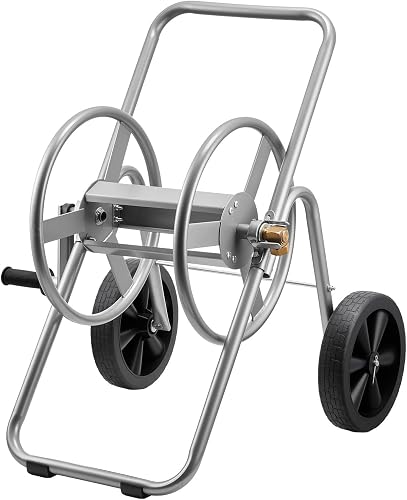
8. VEVOR 200/300 Ft High-Pressure Cart
VEVOR 200/300 Ft High-Pressure Cart
- Holds 200 ft of 5/8 in or 300 ft of 1/2 in hose
- Two wheels
- Gear-driven rewind
- Mesh storage basket
A gear-driven manual rewind distinguishes this two-wheel cart from simpler crank designs. Its high-pressure name does not replace the need to confirm operating limits for your equipment.
Pros
- Capacity stated for two hose sizes
- Gear-driven rewind
- Mesh storage basket
Cons
- Larger capacity applies to 1/2 in hose
- Washer use requires confirmed pressure and temperature limits
Choose this VEVOR for its gear-driven manual rewind, rather than assuming the high-pressure name makes it suitable for any washer. VEVOR describes the mechanism as allowing one-handed cranking, but you still turn the handle yourself.
Its capacity is 200 ft with 5/8 in hose or 300 ft with 1/2 in hose. The two-wheel frame has a mesh basket and weighs 16.8 lb empty, which makes it the lightest empty cart in this group.
VEVOR describes an NH 3/4 interface and use with hot and cold water machines. Confirm the working pressure, temperature range and connection requirements before putting the reel into a pressure circuit.
Skip it for washer use if those limits cannot be confirmed. For ordinary garden watering, choose it because you want the winding mechanism and layout, rather than paying attention only to the larger capacity number.
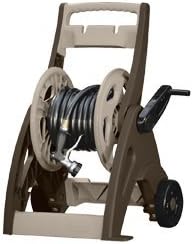
9. Hosemobile 175 Ft Hose Cart
Hosemobile 175 Ft Hose Cart
- Holds 175 ft of 5/8 in hose
- Resin construction
- Fully assembled
- Easylink connection system
Choose this resin cart when skipping frame assembly matters more than maximum hose capacity. You still need to connect and load your hose before watering.
Pros
- Comes fully assembled
- Resin construction
- Easylink connection system
Cons
- Lower capacity than most picks
- Weighs 36.5 lb
The Hosemobile suits buyers who want to avoid assembling a cart frame. It comes fully assembled, leaving hose attachment and loading as the main setup tasks.
Its resin construction sets it apart from the metal carts here, and it holds 175 ft of 5/8 in hose. The Easylink system connects the reel and hoses, though correct seating and sound hose washers still matter when you connect any watering setup.
Do not choose it on the assumption that resin means a lighter cart. At 36.5 lb, it weighs more than several metal options, even before you load the hose.
Skip it if low empty weight or room for a very long hose matters most. It makes more sense when avoiding bolts and frame assembly is a clear priority and your existing hose fits comfortably within its capacity.
What should you check before buying a hose reel cart?
Check hose fit, travel access and parking space before comparing extras. Those 3 details determine whether the cart will work in your yard every day.
Match your hose to the best hose reel cart
Use both the hose's diameter and length when checking reel capacity. A capacity given for 1/2 in hose does not apply to a thicker hose of the same length.
Leave room for orderly layers rather than choosing a reel that only works when packed perfectly. Thick hose walls and bulky couplings can affect how neatly the hose fits, even when its nominal diameter matches.
For more help with the size tradeoff, see 5/8 vs 1/2 hose reels. A larger reel does not correct weak flow caused by an unsuitable hose or water supply.
Walk the route before choosing wheels
Measure gates and check gravel, soft soil, steps and shed thresholds. Solid and airless tires avoid puncture-related inflation work, but they do not remove the effort of moving a loaded reel over obstacles.
Two-wheel carts usually require tilting, which puts part of the load through the handle. Four-wheel carts support the frame during travel, but you still need room to turn them.
Allow working space around the reel
Leave clearance for the crank, the hose outlet and your feet. A cart squeezed into a corner may fit in storage yet be awkward to use there.
Check the leader hose path as well. It should reach the faucet without stretching across a walkway or forcing a tight bend at either connection.
For a broader comparison, see our guide to choosing a hose reel.
How much hose should you load onto a cart?
Load enough hose for your actual route, not the longest length the reel can hold. Extra hose adds weight, creates more winding work and can reduce flow over a long run.
Measure around beds and buildings rather than drawing a straight line from the faucet. Include enough slack to work comfortably at the farthest spot without pulling the cart toward you.
If several faucets serve the yard, moving a shorter hose between them may be easier than managing one very long hose. Disconnect the leader before moving the cart beyond its reach.
For an existing 100 ft hose, compare suitable options in our best hose reels for 100 ft hoses. Our guide to hose reel parts and fittings explains the connections you will encounter during setup.
How do you set up and load a hose reel cart?
Assemble the cart fully, check its fittings and load the hose in even layers. Start on firm, level ground with space to lay the hose out.
- Check the hardware. Fit washers, wheel retainers and fasteners as the instructions show, then check that the crank turns without binding.
- Inspect hose connections. Make sure hose washers are present and clean, then start threaded connections by hand to avoid cross-threading.
- Attach the inner hose end. Route it toward the reel without a crushed bend or a loop that catches the frame.
- Straighten the main hose. Remove twists and open any tight loops before winding.
- Crank slowly. Guide the hose across the drum, keeping fingers clear of moving guides and pinch points.
- Connect the leader hose. Turn on the faucet gradually and inspect each joint before beginning work.
Do not add thread tape automatically to every hose joint. Connections that seal against a flat rubber washer usually need a sound washer and correct seating, rather than tape packed around the threads.
If a connection drips, shut off the water and release pressure before adjusting it. Forcing a fitting tighter can damage threads without fixing a missing or worn seal.
Our guide to putting hose on a hose reel cart covers loading in more detail.
How do you keep a cart easy to use?
Pull out the length you need before watering, then remove twists before rewinding. Position the cart so the hose pulls toward the work area without wrapping around the frame.
After watering, close the faucet and release pressure through the nozzle. Drain as the cart and hose instructions direct, especially before storage or moving a heavy loaded reel.
Brush off soil and grit before they build up around the guide or fittings. Keep the basket for small accessories rather than treating it as a shelf for heavy loads.
Check loose fasteners, wheel retainers and hose washers from time to time. Touch up damaged frame coating with a compatible finish, and follow the cart's care instructions for moving parts.
Before freezing weather, drain the leader, reel water path and main hose. Use our hose reel winterizing guide to plan storage, since an outdoor coating does not protect trapped water from freezing.
Which mistakes make a hose reel cart harder to use?
The biggest mistakes are overloading the reel, pulling at a sharp angle and cranking through resistance. Each can turn simple hose storage into extra work.
- Buying by the largest number: Match the stated capacity to your hose diameter.
- Using the hose to drag the cart: Move the frame by its handle, with the leader disconnected when needed.
- Winding a snagged hose: Free the snag first rather than forcing the crank.
- Piling hose at one end: Spread each layer so the reel keeps its usable space.
- Parking on a slope: Support feet and a low frame are not substitutes for a secure, level spot.
- Leaving connections under tension: Give the leader enough slack to protect the faucet and reel inlet.
If winding suddenly becomes stiff, stop and inspect the hose path and assembly. More force can hide the cause until a fitting, guide or handle is damaged.
Is a hose reel cart better than a hose reel box?
A cart is better when you need to move the reel, while a box suits hose storage at one regular watering point. Choose around the movement you actually need, rather than the appearance alone.
A cart can move between faucets or roll into winter storage. It also occupies floor space and needs a clear travel route.
A box can keep the hose enclosed near a patio or tap. If every watering task begins at that same spot, cart wheels may add little value.
Read hose reel cart vs hose reel box for a closer comparison of those layouts.
Which best hose reel cart fits your routine?
Choose your best hose reel cart by the job you repeat most often. Use capacity to narrow the choices, then decide how you want to move and rewind the hose.
Pick the WERMAH four-wheel model for long-hose storage in a large yard. Choose the Real Hose Stor for routine watering with a lighter empty steel frame and an included leader.
Choose the smaller Giraffe Tools cart for a shorter route, or its larger guided model when frequent winding is the main chore. The Hosemobile suits buyers whose first priority is skipping frame assembly.
Before ordering, measure the parking spot and walk the route with gates open. If the VEVOR four-wheel option fits that plan, read the VEVOR 250 Ft Hose Reel Cart review for a closer look.
Our top 3 picks at a glance
-
1
-
2
-
3
Frequently asked questions
What size hose reel cart should I buy?
Buy a cart rated for your hose's diameter and full length, with space for orderly winding. Capacity for a narrow hose does not carry over to a wider one.
Measure your actual watering route first, since buying extra hose also adds weight, storage bulk and winding work.
Are four-wheel or two-wheel hose reel carts better?
Four wheels suit buyers who want the frame supported while rolling, while two-wheel carts usually need tilting for travel. The better choice depends on your route and ability to handle the loaded cart.
Check gates, steps and parking ground, since wheel count alone does not settle those practical limits.
Do hose reel carts include a garden hose?
Do not assume a hose reel cart includes the main watering hose. Several carts here include only a short leader hose, which connects the faucet to the reel.
Check both hose requirements before buying, and allow enough leader length to park without pulling tightly against the faucet.
Can a hose reel cart hold a pressure-washer hose?
Only use a reel in a pressure-washer circuit when its pressure limit, temperature limit, swivel and connections match the equipment. A garden-hose connection alone does not mean suitability.
A reel supplying water to a washer's inlet has a different role from one carrying pressurized water from the pump.