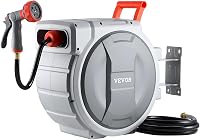
5/8 vs 1/2 Hose Reel: Which Size Should You Buy? (October 2026)
For a 5/8 vs 1/2 hose reel, choose 5/8 in for sprinklers and filling tasks where flow matters; choose 1/2 in for routine nozzle watering and a lighter reel. Your faucet supply and watering tool determine the flow you can use.
On this page (10 sections)
- 5/8 vs 1/2 hose reel: which size has more flow?
- Who should buy the VEVOR 5/8 in reel?
- Who should buy the VEVOR 1/2 in reel?
- Which hose reel is easier to install and handle?
- Do the 5/8 in and 1/2 in reels reach equally far?
- Which shared features will matter during watering?
- How should you set up either reel?
- How do you keep the hose and rewind working well?
- What mistakes lead to the wrong hose reel choice?
- Final choice: 5/8 vs 1/2 hose reel
For a 5/8 vs 1/2 hose reel, choose the wider hose for sprinklers and filling jobs where flow matters, or the narrower hose for everyday nozzle watering and a lighter reel. Neither diameter can make up for a weak water supply.
These VEVOR reels offer the same reach and similar watering features. Your decision comes down to the tool at the end of the hose, the route across your yard and how you'll install the reel.


5/8 vs 1/2 hose reel: which size has more flow?
A 5/8 in hose generally preserves more flow over an equal length because its wider passage creates less resistance. VEVOR also describes higher flow for its wider model, though there's no stated gallons-per-minute figure for either reel.
Flow means how much water comes out over time. Pressure helps push that water through the hose, fittings and watering tool, but a strong-looking spray doesn't necessarily move a large volume.
That difference matters when filling a watering can or supplying a sprinkler. A narrow jet can look forceful while delivering less water than a broad, open stream.
What affects a 5/8 vs 1/2 hose reel choice besides diameter?
Your faucet supply, hose length and connected tool all affect usable flow. A wider hose reduces one restriction in that chain; it doesn't raise your home's supply pressure.
Small-bore adapters, partly closed valves and kinked sections can also limit delivery. Check those before replacing a reel because a sprinkler seems weak.
A bucket and timer can help you judge your supply: measure how long it takes to fill a known volume at the faucet. That gives a starting point, while the hose and attached tool will add resistance.
Don't choose the wider reel just to get a sharper cleaning spray. A garden nozzle changes the spray pattern, but neither reel replaces a pressure washer.
Who should buy the VEVOR 5/8 in reel?
Choose the wider VEVOR reel if sprinkler use or moving larger amounts of water drives your decision. It's the stronger fit for someone who alternates between hand watering, filling containers and watering farther parts of the yard.
The larger passage is useful when you want to avoid adding unnecessary resistance to a long watering route. It also gives you more reason to choose this model if your current narrow hose leaves a suitable sprinkler short of water.
For car washing, the main benefit would be delivering rinse water, rather than creating pressure. For garden beds, you can still reduce output at the nozzle when plants need a gentle soak.
Skip this model if most of your work is slow, close-range watering and lower installation weight matters more. A wider hose offers little practical gain when you deliberately keep the nozzle barely open.
Also skip both models if your yard needs a reel that moves between faucets. These are fixed wall-mounted choices, so selecting the larger diameter won't solve a poor mounting location.
Who should buy the VEVOR 1/2 in reel?
Choose the narrower VEVOR reel for routine hand watering when you value a lighter unit more than maximum flow. Pots, raised beds and nearby planting areas are good reasons to favor it.
A nozzle often limits output during gentle watering anyway. If your routine involves moving from pot to pot and soaking each one slowly, extra potential flow may not change the job.
The narrower reel also makes sense when installation or seasonal removal is a key concern. Its lower weight helps during those tasks, although you still need a secure mount and a safe lifting plan.
Skip it if a demanding sprinkler at the far end of the route is your main use. Start with the wider option and confirm the sprinkler's needs before ordering.
Don't assume the narrower model will be easier to pull simply because the reel weighs less. Pulling effort also depends on spring tension, hose routing and friction against the ground.
Which hose reel is easier to install and handle?
The 1/2 in reel is lighter to lift, but both need structural support. It weighs 25.6 lb, compared with 31.8 lb for the wider model, a difference of 6.2 lb.
Once mounted, the bracket carries the reel during watering. Weight matters most while lifting it into position, removing it for storage or working where access is awkward.
Arrange help if you can't hold the unit steady while fitting it. Choose a mounting height that lets you reach the hose and inspect the connections without stretching.
Check the wall construction before drilling. Decorative siding isn't the support itself, and the correct fixing method depends on the structure behind it.
Our guide to mounting a hose reel on vinyl siding or brick explains why the surface changes the installation plan. Follow the reel's instructions for bracket placement and suitable fasteners.
Do the 5/8 in and 1/2 in reels reach equally far?
Yes, each has a 100 ft main hose and a 6 ft leader hose. The leader connects the faucet to the reel; it doesn't add usable watering distance beyond the reel housing.
Measure the route your hose must follow, rather than a straight line across the yard. Walk around raised beds, patio furniture and corners to find the farthest point you actually need to reach.
Leave enough slack to move the nozzle comfortably. A route that only just reaches on paper can leave the hose pulling against plants or the bracket during use.
Place the reel where its hose can leave in a clear direction. Mounting close to the faucet helps with the leader connection, but a blocked exit can make every watering trip awkward.
For help matching length to your yard, see what size hose reel you need. If you're comparing other options at this length, our guide to hose reels for 100 ft hoses covers different reel styles.
Which shared features will matter during watering?
Both models provide an any-length lock, slow rewind, a 180° swivel bracket and a nozzle with 9 spray patterns. Those features support the same basic routine: pull out what you need, lock it and guide it back afterward.
The lock is useful when watering nearby pots because you don't need to pull out the full hose. Stop with a little working slack so you can move without tugging against the locked reel.
The swivel lets the housing follow your direction across the yard. It doesn't keep the hose from catching on a step, shrub or sharp corner farther along the route.
Choose nozzle patterns by the job. Use a gentle setting for seedlings, direct water toward the soil around established plants and avoid blasting loose mulch out of a bed.
Slow rewind still needs your attention. Walk the hose back toward the reel and keep control of the nozzle so it can't swing into a person, window or plant.
How should you set up either reel?
Plan the mount and hose route before connecting water, then check for leaks at low flow. A careful setup prevents avoidable strain on the bracket, leader hose and fittings.
- Check the route. Confirm that the hose reaches your farthest watering point with room to move, and that the housing can swivel without hitting a nearby object.
- Mount to suitable support. Follow the instructions for your wall type and keep the work area clear while lifting the reel into place.
- Connect without twisting the leader. Give it a relaxed route to the faucet, away from sharp edges and spots where people walk.
- Inspect the seals. Seat washers properly and start threaded connections by hand to avoid cross-threading.
- Open the faucet slowly. Check the faucet, leader connections and nozzle before pulling the hose across the yard.
- Learn the lock and release. Practice with a short section in a clear area before using the full route.
Hose diameter and connector size describe different things. Don't buy adapters just because a reel has a narrower hose; check the actual connections on the faucet and accessories.
If a threaded connection drips, turn off the supply before loosening it. Check alignment and the washer before applying more force, since overtightening can damage a connection.
Our guide to hose reel safety and secure mounting covers recoil control and bracket support in more detail.
How do you keep the hose and rewind working well?
Keep the hose path clear, guide retraction and protect the reel from trapped freezing water. Daily care matters for both diameters because dirt, kinks and snags add strain during use.
Before retracting, untangle loops and remove mud or grit with a damp cloth as needed. Don't make the spring drag a nozzle around a corner or pull a snagged hose free.
Keep fingers away from the hose guide and housing opening during rewind. If the hose stops, pause and check the exposed route rather than pulling harder or opening the spring housing.
After watering, shut off the faucet and release trapped pressure through the nozzle before storage, following the manual. Don't leave the system pressurized simply because the nozzle trigger is closed.
Both reels have PP housings that VEVOR describes as freeze-resistant. That doesn't prevent water trapped inside the hose or fittings from expanding when it freezes.
Follow the seasonal storage instructions for your climate. Our guide to winterizing a hose reel explains the draining and storage steps to plan before cold weather.
What mistakes lead to the wrong hose reel choice?
The biggest mistake is choosing by diameter before checking the watering task and mounting site. Either size can disappoint if it doesn't reach, can't be supported safely or feeds the wrong tool.
Buying a wider hose to fix every weak spray
A wider hose can reduce resistance, but it won't fix a partly closed faucet or a clogged nozzle. Check the simple causes first, then decide whether hose diameter is limiting the job.
Choosing only by reel weight
A lighter unit helps during installation, but it doesn't prove easier pulling or gentler recoil. Think about daily hose routing as well as the lift onto the bracket.
Paying for reach you can't use
Extra length doesn't help if the hose must cross a busy walkway or bend around a sharp wall edge. Move the planned mounting point or reconsider the reel style before accepting that route.
Assuming any replacement hose will fit
Retractable reels must match the hose to the spool, guide, fittings and spring system. Don't plan to convert the narrower model later without VEVOR's approval for the exact replacement.
If choosing your own hose is a priority, read about buying a hose reel with or without a hose. That choice may matter more than the small differences between these two complete units.
Final choice: 5/8 vs 1/2 hose reel
Pick the 5/8 in VEVOR for sprinkler use and filling tasks; pick the 1/2 in VEVOR for everyday nozzle watering and a lighter installation lift. For this 5/8 vs 1/2 hose reel decision, start with what you need the water to do.
Choose neither until you've confirmed a safe mounting point and a clear route. If you need to move between watering areas, our overview of hose reels for home can help you choose another style.
Use how to choose a hose reel to check type and diameter together, or the hose reel size guide to settle reach before ordering.
Frequently asked questions
Is a 5/8 in hose better than a 1/2 in hose?
A 5/8 in hose is the better choice when preserving flow over a long run matters, such as feeding a sprinkler or filling containers; a 1/2 in hose suits routine nozzle watering when your tool gets enough water. Choose around the task, then check reach and mounting needs.
Does a 5/8 in hose reel water faster?
A wider hose can deliver more water by reducing resistance, provided your faucet and watering tool allow that extra flow; it won't shorten every watering job, especially when you use a gentle spray. Neither VEVOR reel has a stated gallons-per-minute figure here, so there's no exact speed comparison.
Are both VEVOR reels the same length?
Yes, both have a 100 ft main hose and a 6 ft leader hose; the leader connects the faucet to the reel, so don't count it as extra reach beyond the reel. Measure the actual route around beds, corners and furniture before deciding where to mount either model.
Should I use a 5/8 in reel for a sprinkler?
Choose the 5/8 in reel when sprinkler flow is your main concern, especially over a long hose route; check the sprinkler's required flow and pressure against your supply. A wider hose reduces one source of resistance, but it can't make an undersupplied faucet support a water-hungry sprinkler.
Can I replace a 1/2 in reel hose with a 5/8 in hose?
Only change hose diameter if VEVOR approves that replacement for your exact reel; a wider hose takes more spool space and may not suit the fittings, guide or spring mechanism. Matching the original hose length isn't enough to establish fit, and forcing a larger hose can prevent proper retraction.