Hose Reel Safety Basics: Spring Recoil and Secure Mounting
A retractable hose reel spring stores energy as you extend the hose and uses it to rewind. Choose enough reach for your yard, secure the reel to suitable support, and guide the hose back under control with people clear of its path.
On this page (10 sections)
- How does a retractable hose reel spring work?
- Which reel length and hose size should you choose?
- How can you control hose recoil?
- What should you check before mounting a reel?
- What should you check after mounting?
- When does a freestanding reel stand make sense?
- What setup and care habits protect the reel?
- What if the hose or spring acts unexpectedly?
- Which common mistakes should you avoid?
- Which retractable hose reel spring setup should you choose?
A retractable hose reel spring stores energy when you extend the hose and uses it to rewind, so choose the right reach and guide every return. A secure mount and a clear hose path matter as much as the rewind feature.
For routes within 100 ft, consider the VEVOR here if slower return is your priority. Choose the Giraffe Tools model for extra reach, and consider a separate stand only when its fit and ground conditions suit your reel.
Neither mounting accessories nor a longer hose can solve a poor installation location. For a broader overview of reel types, start with our guide to hose reels for home.
How does a retractable hose reel spring work?
A retractable hose reel spring stores energy as you pull the hose out, then draws it back when the lock releases. The spring provides the pull, while the lock and hose guide help control when and how the hose returns.
Many reels let you stop at the length you need rather than leaving the hose under constant pull. That makes it easier to water a bed without holding back the rewind mechanism.
The spring doesn't clear obstacles, untwist a hose caught around a pot, or protect the nozzle from hitting a wall. Your job is to keep the return route open and control the hose outside the housing.
For a closer look at the parts and the usual rewind sequence, see how a retractable hose reel works.
How does a retractable hose reel spring release the hose?
The hose lock releases according to the model's instructions, often through a short pull. Learn that sequence before extending the full hose, so you can stop and restart the return without guessing.
A reel that won't release isn't an invitation to pull harder. Check the instructions and visible hose path, keeping fingers away from the opening and leaving the housing closed.
Which reel length and hose size should you choose?
Choose enough hose to follow your actual watering route, with some slack at the farthest point. Measure around beds, fences, and corners rather than drawing a straight line from the tap.
Separate the route into 2 measurements: tap to reel, then reel to the farthest watering point. The leader hose serves the first distance and doesn't add usable reach beyond the reel.
A longer hose helps when a planting area sits beyond the shorter model's reach. It also leaves more hose to manage when fully extended, so extra length should solve a real need.
Both complete reels here use a 1/2 in hose. That can suit routine plant watering, but hose diameter and total length matter if your main job involves filling large containers or running equipment that needs more flow.
A reel doesn't boost the pressure supplied by your tap. For help deciding whether a larger bore would suit your work, read our 5/8 vs 1/2 hose reel comparison.
Choose the mounting location before settling on length. Our guide to choosing the right hose reel size explains how to match reach to the area you water.
How can you control hose recoil?
Hold the hose and walk it back along a clear route, following the reel's rewind instructions. Keep your hands outside the housing and your body clear of the moving hose and nozzle.
Before releasing the lock, free the hose from furniture legs, pots, and garden tools. Move children and pets away from the route rather than trying to steer a returning hose around them.
Use these habits during each return:
- Hold the hose without wrapping it around your wrist or arm.
- Let the reel take up slack while you keep control.
- Avoid dragging the nozzle across paving or into the housing.
- Stop if the hose catches or begins feeding unevenly.
- Keep fingers away from the hose guide and housing opening.
Don't use the spring to pull the hose free from an obstacle. Release the tension as directed, clear the snag, and resume only when the hose has an open path.
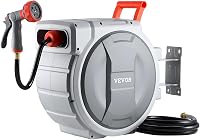
The VEVOR has an automatic slow-rewind system. VEVOR specifies a return time of 10 to 11.5 seconds per 30 meters, making it the more relevant choice here when return speed is your main buying concern.
This model suits a fixed watering area within its reach, especially if you want to pull out only the length needed and lock it there. Its 6 ft leader hose also gives some room between the tap and mounting point.
Skip it if the measured route is longer or you need a wider hose for your main task. The included 9-pattern nozzle offers spray choices, but nozzle patterns shouldn't decide whether the reel fits your yard.
What should you check before mounting a reel?
Attach the reel to suitable structural support with the specified hardware. A screw fitting through a bracket hole doesn't mean it can carry the reel and the forces created during hose use.
Check the complete instructions before choosing drill bits, anchors, or a mounting height. The finished position should let you reach the hose comfortably without making it scrape the ground or rub against a sharp edge.
Confirm these points before drilling:
- The wall or post can support the reel in the required way.
- Fastener type, size, and spacing match the installation instructions.
- The leader hose reaches the tap without a tight bend or stretched connection.
- The housing has room to swivel without striking a fence or pipe.
- The hose can leave the guide toward the main watering area.
- The location doesn't create a hose crossing at a busy doorway.
Check for concealed wiring or pipes before drilling. If the wall construction or fastening method is unclear, ask a qualified installer to resolve it.
The Cimple kit contains plastic anchors and cable screw clips for general mounting tasks. THE CIMPLE CO names several compatible surface materials, but that doesn't guarantee hose reel load suitability.
This kit suits buyers who already know the fastener requirements for a separate mounting task. Skip it as an assumed substitute for the reel's specified anchors, screws, or structural attachment.
For siding, brick, and other wall types, see our guide to mounting a hose reel on vinyl siding or brick. Surface covering and the support behind it need separate consideration.
What should you check after mounting?
Confirm that the reel, bracket, and support stay still during normal hose movement. Begin with a short extension and the instructed return sequence while watching for movement at the mounting points.
Stop if the bracket lifts, the surface cracks, or a fastener pulls outward. Repeated tightening won't repair a damaged anchor hole or make unsuitable wall material carry the load.
Next, extend the hose toward each area you plan to water. Check that the housing follows the pull without hitting nearby objects and that the hose doesn't scrape across the bracket.
The Giraffe Tools model combines a 130 ft retractable hose with a 5 ft lead hose, an any-length lock, and a two-point bracket. Its 180° swivel supports watering in different directions from one fixed position.
Choose it when the farther bed or side yard falls beyond the VEVOR's reach. Its aluminum hose guide and quick-release removal are also useful features for buyers planning regular hose storage.
Skip it if a shorter route covers your yard or you need greater flow than a long 1/2 in hose suits. If mounting on a post, Giraffe Tools calls for one larger than 4 x 4; check the full instructions before building the support.
When does a freestanding reel stand make sense?
A separate stand makes sense when the best watering location has no suitable wall. It still needs a compatible reel bracket and ground that can hold the support during repeated pulls.
The Trieez stand uses a metal structure and a four-pronged base inserted into soil. It includes mounting parts and hand tools, but it isn't a reel or a replacement for confirming the reel's mounting requirements.
Consider it for a soil location that gives the hose a straighter route to your beds. Confirm bracket hole alignment, attachment method, and load suitability for your exact reel before choosing the pair.
Skip it for a paved-only location or soil that won't hold the base firmly. Loose fill, very soft ground, and changes after heavy rain can affect how securely a soil-mounted support stays upright.
Keep a stand out of paths where its base could become a trip point. After moving it, repeat the stability checks rather than assuming it will hold as well in the new spot.
What setup and care habits protect the reel?
Follow the connection and storage instructions, and keep the hose route clean and free of sharp bends. Care should focus on the visible hose, fittings, guide, and mount rather than the enclosed spring.
Before connecting the leader hose, check that its sealing washer is present and seated correctly. Start threaded fittings straight, and don't use extra force to compensate for a damaged washer or crossed threads.
Turn the water on gradually and check connections for leaks. Follow the reel's instructions for shutting off the tap and releasing water pressure after use.
Wipe grit from the hose before it enters the guide when needed. Don't spray lubricant into the housing or add oil to the spring unless the manufacturer specifically directs it.
Check visible fasteners and the support regularly, particularly after moving a stand or noticing a change in how the hose pulls. Look for hose cuts, bulges, worn spots, and contact points where the hose rubs.
Protect the system before freezing weather arrives. Giraffe Tools advises against outdoor winter storage, and even a cold-resistant housing doesn't make trapped water safe to leave inside.
Drain and store the equipment according to its instructions. Our hose reel winterizing guide covers the seasonal steps in more detail.
What if the hose or spring acts unexpectedly?
Stop the rewind and check permitted external causes first if the hose catches, jerks, or stops short. A poor return doesn't by itself prove that the spring has failed.
Check for a hose trapped under an object, a twist outside the housing, or a return angle that rubs against the guide. Don't pull harder or force a bunch of loose hose into the opening.
A change in return speed, repeated lock failures, or unusual scraping needs attention before further use. Keep the housing closed and follow the manufacturer's troubleshooting process.
Giraffe Tools specifically advises against taking apart internal components when its reel won't retract properly. Contact its support team instead of trying to add spring tension or remove the spring.
For a step-by-step look at external causes, see why a retractable hose reel may not retract. To identify the visible components, read hose reel parts explained.
Which common mistakes should you avoid?
Avoid pulling against a lock, choosing hardware by appearance, and buying length without measuring. These mistakes create problems that a different spray nozzle or stronger tug won't solve.
Don't count the leader hose as extra garden reach. It connects the tap to the housing, so choosing a reel from a combined hose length can leave your farthest bed out of reach.
Don't treat a swivel bracket as permission to pull from any angle. Give it clearance to move, and position the reel so the hose can feed toward your usual route.
Don't leave a stretched hose across steps or a walkway while taking a break. Return it under control or place it clear of foot traffic without creating a sharp bend.
Don't leave a known mounting fault for later. A leaning stand or moving bracket calls for a mounting fix before the next watering job.
Which retractable hose reel spring setup should you choose?
Choose VEVOR for a route within its reach when slow rewind is the priority, or Giraffe Tools when the extra hose length solves a measured need. Neither choice removes the need to guide the hose and secure the mount.
Choose the Trieez stand only after confirming reel fit, load suitability, and firm soil. Treat the Cimple kit as general mounting hardware whose suitability must be established for the exact task.
If you're shopping for a replacement retractable hose reel spring, check the reel's model and service options first. Buying another reel, an anchor kit, or a stand won't repair an internal fault in your current unit.
Settle the reach and support location before comparing convenience features. For more help matching the reel and mounting method to your space, see the buying guides.
Frequently asked questions
Can a retractable hose reel spring hurt you?
Yes, a hose returning without control can strike someone, while opening the housing can expose a spring under tension. Keep people clear, hold the hose without wrapping it around your hand, and follow the rewind instructions; leave internal spring work to the manufacturer's service process.
Should I let a retractable hose reel snap back?
No, keep control of the hose and walk it back along a clear route as instructed. A slow-rewind feature helps manage return speed, but it doesn't clear obstacles or keep a nozzle from striking something; stop if the hose catches rather than pulling harder against the snag.
How do I mount a retractable hose reel safely?
Attach the bracket to suitable structural support using hardware specified for the reel and surface; allow room for the housing to swivel and the hose to feed without scraping. If the instructions don't cover your wall construction, ask a qualified installer to choose the mounting method.
Can I repair a retractable hose reel spring?
Follow the manufacturer's service instructions instead of opening the housing or adding spring tension yourself. A rewind fault may involve the hose path, lock, or guide rather than a broken spring; check only the external items the instructions allow, then contact support if the fault remains.
Is a freestanding hose reel stand safer than wall mounting?
Neither method is automatically safer; a stand needs compatible brackets, suitable load capacity, and soil that holds it firmly during hose movement. A wall mount needs suitable structural support and fasteners; choose the method you can install correctly, and stop using either setup if it shifts.