How Does a Retractable Hose Reel Work?
A retractable hose reel works by storing energy in a spring as you pull the hose out. A lock holds your chosen length, then releases so the spring can rewind the hose through a guide.
On this page (9 sections)
- How does a retractable hose reel work step by step?
- Why does the hose stay out when you stop pulling?
- What releases the lock and starts rewind?
- Why should you guide the hose as it rewinds?
- What role do the bracket and swivel play?
- How do you choose the right reach and hose size?
- How should you set up a wall-mounted reel?
- What care and common mistakes affect rewind?
- How does a retractable hose reel work for your yard, and which should you choose?
A spring-powered retractable hose reel works by storing energy as you pull the hose out, holding it with a lock, and using that energy to rewind it. You release the lock when you're finished, then guide the hose back into the case.
Water pressure doesn't power this return action. Water travels through the hose for watering, while the spring, drum, and lock handle storage.
For buying, focus on reach, hose diameter, mounting support, and controlled return. Extra spray patterns won't help if the hose falls short or the bracket has nowhere secure to attach.
How does a retractable hose reel work step by step?
A retractable reel winds up its spring during pullout and releases that stored energy during rewind. The lock separates those actions so the hose can stay extended while you water.
- Pull the hose toward your watering area without jerking it.
- Let the catch engage using your model's locking method.
- Water with the hose held at the needed length.
- Release the catch, often with a short tug.
- Walk the hose back as the spring turns the drum.
You don't need to pull out the entire hose for a nearby bed. Using only what you need leaves less hose across paths and fewer loops to catch on furniture.
What happens inside a retractable hose reel when you pull the hose?
Pulling the hose rotates the drum against spring tension. Once the catch engages, it holds the drum still despite the spring's pull.
During return, the drum turns the other way and gathers the hose. A guide directs it onto the drum; a moving guide can help spread it across the winding area.
The water connection has a separate job: it carries water into the hose while allowing the reel to turn. See hose reel parts and what they do for the roles of the swivel, guide, and stopper.
Why does the hose stay out when you stop pulling?
A catch or ratchet prevents the spring from turning the drum backward. That holds the hose out without making you resist the rewind force throughout watering.
Some reels lock at intervals, while others offer any-length locking. All 3 models below offer any-length locks, though you still need to learn the release motion for your reel.
After extending the hose, ease your pull to check that it has caught before walking farther away. Repeated hard yanks can confuse the release sequence and put needless force on the mount.
If the catch won't hold or release, follow the manual's troubleshooting steps. Read why a retractable hose reel may not retract if clearing the hose path doesn't solve the problem.
What releases the lock and starts rewind?
On many spring-powered reels, a brief tug releases the catch so the drum can turn back. Follow your model's instructions for the motion rather than pulling farther and harder.
The Giraffe Tools model uses a slight tug to start return. Its aluminum guide directs the hose during rewind, while its any-length lock lets you stop short of full extension.
The Giraffe Tools 130 Ft Retractable Reel suits a yard with a long watering route: it includes 130 ft of retractable 1/2 in hybrid hose, plus a 5 ft lead hose. The lead connects to your faucet and doesn't add to the hose you pull across the yard.
Skip it if a shorter reel reaches every bed or your mounting space is tight. Its case measures 22 x 19 x 12 in and weighs 28.4 lb, so allow room for both the housing and its swing.
Why should you guide the hose as it rewinds?
Guiding the hose controls the moving end and keeps snags from becoming hard pulls. Automatic return saves winding effort, but you still manage the hose's route.
Clear loose loops and obstacles before releasing the catch. Walk toward the reel with the hose in hand, keeping fingers away from the guide and housing opening.
Don't leave the nozzle to bounce across paving or drag through a flower bed. Slow return can reduce sudden pullback, but it can't steer the hose around a chair.
The Ayleid 100 Ft Retractable Reel suits buyers who want a rubber-polymer hybrid hose with slow return. It has a 1/2 in hose, a self-aligning guide, and a quick-release mount for off-season removal.
Skip it if your route needs more than 100 ft or you need a reel that moves between watering areas. Ayleid advises draining the hose and storing the unit indoors during winter, so plan storage space before mounting it.
What role do the bracket and swivel play?
The bracket supports the reel and takes the force of pulling and rewinding. A swivel lets the case turn toward your work area, reducing the need to pull sideways across the outlet.
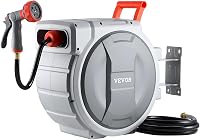
The VEVOR 1/2 In 100 Ft Retractable Reel pairs a 180° swivel bracket with a 100 ft main hose and 6 ft leader hose. Its 3-layer PVC hose and brass fittings suit buyers choosing a PVC setup with controlled return.
VEVOR says its slow rewind returns 30 meters of hose in 10 to 11.5 seconds. Choose it when its reach fits your yard and you want that stated return-speed range.
Skip it if you prefer a hybrid hose or can't provide secure wall support. The supplied anchors and screws still need to match the surface; included hardware doesn't make every wall suitable.
How do you choose the right reach and hose size?
Choose the shortest hose that comfortably follows your actual watering route, with room to move around the farthest bed. Measure along paths and around corners, rather than drawing a straight line across the yard.
Keep leader length separate from usable reach. Position the reel close enough to the faucet that the connecting hose has slack and doesn't strain either fitting.
All 3 models here use 1/2 in hose. For long watering runs or tools that need more water, compare 5/8 vs 1/2 hose reels before choosing by length alone.
A narrower or longer hose generally creates more flow resistance. A reel stores hose; it doesn't boost pressure, and a jet nozzle doesn't turn it into a pressure washer.
For help mapping reach to your yard, use our hose reel size guide. Buying far more hose than you need also means finding space and support for a larger unit.
How should you set up a wall-mounted reel?
Mount the reel on support suited to its weight and repeated pulling forces, with space for the case to swivel. Check the hose route, faucet connection, and mounting surface before drilling.
Dry-fit the location and confirm that doors, gates, and walkways remain clear. Follow the manual for bracket position, fasteners, and any required structural backing.
Don't assume decorative siding can carry the load. See whether you can mount a hose reel on vinyl siding or brick before choosing anchors or drilling through a wall finish.
Connect the leader without twisting it, then turn on the water slowly and check the joints for leaks. Extend and return the hose under control to learn the catch before using it across the yard.
What care and common mistakes affect rewind?
A clear hose path and clean guide help the reel return without extra resistance. Stop when the hose catches rather than using the spring to drag it free.
Brush away loose grit before it enters the case, and inspect accessible hose sections for damage. Don't pull past the reel's marked extension limit or force the final length from the drum.
Turn off the faucet after use and release trapped pressure through the nozzle as directed. A closed nozzle alone leaves the hose and its connections under pressure.
Don't open the spring housing to fix a jam. Giraffe Tools directs users with return problems to support rather than internal disassembly.
Drain and store the reel according to its instructions before freezing weather. Cold-resistant materials don't prevent trapped water from freezing; follow how to winterize a hose reel for seasonal steps.
How does a retractable hose reel work for your yard, and which should you choose?
Choose a retractable reel when one secure mounting point can serve your watering area and you want the spring to handle winding. Choose a manual reel if you prefer direct control with a crank, or a cart if you need to move the whole setup.
Pick Giraffe Tools for the longer route, VEVOR for a PVC hose with a stated slow-rewind speed, or Ayleid for a hybrid hose with slow return and quick-release removal. Eliminate any model that falls short or lacks a suitable mounting location.
Compare storage types in our guide to retractable, wall-mount, and cart hose reels, or read whether retractable hose reels are worth it to weigh the daily convenience.
Once you understand how a retractable hose reel works, the decision comes down to fit and controlled use. Before installing one, review hose reel spring and mounting safety so the return mechanism stays enclosed and the bracket stays secure.
Frequently asked questions
How does a retractable hose reel lock the hose?
A catch or ratchet holds the drum against spring tension, keeping the hose out while you water; depending on the design, the lock catches at intervals or at your chosen length. Follow your model's pull-and-release instructions, and stop pulling harder if the catch will not engage.
What makes a retractable hose reel rewind?
A spring stores energy when you pull the hose out, then turns the drum backward when you release the lock; the guide directs the returning hose onto the drum. On these spring-powered models, water pressure does not drive the rewind, and you should leave the spring housing closed.
Should you let a retractable hose snap back?
No, keep hold of the hose and walk it toward the reel during return; clear its path first, keep people and pets away, and keep your fingers away from the opening. A slow-return feature helps control speed, but it does not remove the need to guide the hose.
Why does a retractable hose reel stop rewinding?
A snag, kink, blocked guide, or incorrect release motion can stop the hose from returning; clear the path and follow your model's troubleshooting steps without forcing the hose. If it still will not retract, contact the brand for service guidance rather than opening the spring housing.