Hose Reels for Home: Retractable, Wall-Mount and Cart
Choose a hose reel by reach, mounting location and winding style. A retractable reel provides automatic rewind, a manual wall reel stores a hose near one faucet, and a cart lets you move a longer hose around the yard.
On this page (11 sections)
- Which hose reel type suits your yard?
- What should you measure before buying a hose reel?
- Is a retractable hose reel right for you?
- When does a wall-mount hose reel make sense?
- When should you choose a hose reel cart?
- How do hose diameter and length affect your choice?
- Should you buy a hose reel with or without a hose?
- How should you set up a hose reel?
- How should you use and care for a hose reel?
- Which hose reel buying mistakes should you avoid?
- Which hose reel should you choose?
Choose a hose reel by reach, mounting location and winding style. Pick automatic rewind for frequent watering from one spot, a manual wall reel for simple fixed storage, or a cart for a longer hose that needs to move.
Start with the route your hose must follow, rather than the size of your lawn. A small yard with fences and corners can need more hose than a larger open space.
Your next choice is where the reel will live. A sound wall, a suitable ground mounting point and a clear cart route lead to different buying decisions.
The best fit is the reel you can pull out, use and put away without fighting its placement. The examples below cover those different jobs, with clear reasons to choose or skip each one.
Which hose reel type suits your yard?
Choose retractable storage for automatic rewind, a manual wall reel for fixed storage, or a cart for moving a long hose. Start with the installation your yard supports, then choose how you want to wind the hose.
| Reel type | Good fit when you | Main trade-off |
|---|---|---|
| Retractable wall reel | Water often from one fixed point and want enclosed storage | Needs a sound wall and a clear return path |
| Ground-mounted retractable reel | Want automatic rewind away from a wall | Needs a suitable base location with room around it |
| Manual wall reel | Already have a compatible hose and don't mind cranking | You wind and guide the hose after each use |
| Hose reel cart | Need to move hose storage between areas | Takes up floor space and still needs a water connection |
Wall-mounted describes placement; retractable describes operation. A wall reel can rewind automatically or use a hand crank, so those terms are not competing categories.
A retractable unit stores its hose inside a housing. The manual wall reel and cart covered here use exposed spools, which let you see the hose as you wind it.
Fixed storage makes sense when nearly all your watering starts from the same place. Moving a cart makes more sense when you use different faucets or need to change where the hose begins its working route.
A cart does not create extra reach from the water supply by itself. Its position still depends on how you connect it to the faucet.
Read how a retractable hose reel works for the rewind mechanism. For another storage comparison, see hose reel cart vs hose reel box.
What should you measure before buying a hose reel?
Measure the actual hose route, faucet connection and storage space before choosing a reel. Straight-line distance across the lawn leaves out the obstacles that use up hose length.
Measure the hose reel route around obstacles
Start at the proposed reel position and follow the path to your farthest watering spot. Go around raised beds, steps, fences and furniture instead of measuring through them.
Use a tape measure or string, and include enough slack to move the nozzle comfortably. A hose pulled tight at full extension puts strain on fittings and makes watering awkward.
Check separate routes to the driveway, vegetable bed and back border. The farthest corner on a map may not be the longest usable path.
Do not depend on spray distance to make up for a short hose. You should be able to place the nozzle where the job requires it, including close to pots and plant roots.
Separate hose reel reach from leader hose length
The leader hose joins the faucet to the reel; the main hose runs from the reel to your watering spot. Measure those paths separately so you don't count the same length twice.
A longer leader can allow a different reel position, but it also needs a safe route. Avoid stretching it across a doorway, walkway or mowing path.
Check that both connections can sit without sharp bends. A connection that only reaches when pulled tight is a poor starting point for daily use.
Check hose reel clearance and storage access
Allow room for the housing to swivel or the crank to turn. Check nearby doors, downspouts, shrubs and anything that could block your hand or catch the hose.
For a cart, measure gates and the space where it will park. Include room to stand beside it while winding, rather than measuring only the frame.
Think about seasonal removal too. A reel mounted where you cannot lift or carry it safely will be harder to put away before winter.
Our hose reel size guide covers capacity matching. If your route needs substantial reach, compare hose reels for 100 ft hoses.
Is a retractable hose reel right for you?
Choose a retractable hose reel when putting the hose away is the main chore you want to reduce. It suits regular watering from a fixed point with a clear path back to the housing.
Automatic rewind removes the cranking step, but you still need to guide the hose and clear obstacles. A hose wrapped around a planter cannot return cleanly just because the reel has a spring.
An enclosed reel also ties your choice more closely to the supplied hose. Choose its diameter and length carefully, and confirm replacement options if keeping the unit for years matters to you.
Skip this style if you often change hose lengths, need to carry the whole setup between locations, or cannot provide a secure mounting point. A manual reel may fit those needs better.
VEVOR hose reel: for frequent watering beside a sound wall
The VEVOR 1/2 In 100 Ft Retractable Reel combines a 100 ft main hose and 6 ft leader hose with a 180° swivel bracket. Its any-length lock lets you stop where you need to water.
Choose it for beds, containers and other tasks reached from one wall position. The swivel bracket helps the housing turn toward the work instead of forcing every pull through one fixed angle.
Its slow rewind system is designed to reduce sudden pullback. VEVOR specifies a return time of 10–11.5 seconds per 30 meters, but you should still hold and guide the hose during return.
The included nozzle offers 9 spray patterns. Those settings let you change the spray shape; they do not turn a garden hose into a pressure washer.
Skip this model if higher flow through a long hose is your main need. Its 1/2 in hose deserves a closer look if you want to run a demanding sprinkler or fill large containers quickly.
Also check the mounting task before choosing it: the reel weighs 25.6 lb before you account for the forces from pulling the hose. Supplied fasteners still need to suit the actual wall and installation instructions.
Giraffe Tools hose reel: for watering away from a wall
The Giraffe Tools 92 Ft Ground Reel provides a 92 ft, 5/8 in hose on a ground-mounted unit. It supports lawn or concrete installation and has a 360° swivel base.
Choose it when a useful watering position sits away from the house, such as near a garden bed. Its any-length lock and tug-start rewind suit repeated stops along a watering route.
Ground mounting avoids attaching a reel to the building, but placement still matters. Keep the unit clear of walking routes, mowing equipment and plants that could catch the hose.
The reel weighs 32.5 lb, so plan for lifting and seasonal storage rather than treating it as a portable watering tool. Giraffe Tools recommends indoor winter storage and describes removing the unit by undoing the base screws.
The nozzle, leader hose and swivel base can be replaced. That gives you specific service options, though you should confirm the correct part before ordering a replacement.
Skip it if you have no suitable ground or concrete position, or if its hose cannot reach every required area. A fixed ground reel is not a substitute for a cart when you need to move the whole setup.
For broader trade-offs, read are retractable hose reels worth it?. If an existing unit stops returning, use why a hose reel may not retract to narrow down the cause.
When does a wall-mount hose reel make sense?
A wall-mount hose reel makes sense when one faucet serves most of your watering and you want to keep storage off the ground. Choose manual winding if using your own compatible hose matters more than automatic return.
A manual wall reel can suit a patio or side yard where a cart would block the way. It also gives you direct control over winding speed and hose placement on the spool.
The compromise is that you must return to the reel and crank after watering. If that step is why your hose stays on the lawn, automatic rewind may be worth choosing instead.
Suncast hose reel: for an existing hose near one faucet
The Suncast Sidewinder 100 Ft Wall Reel holds up to 100 ft of 5/8 in standard vinyl hose. It has a resin body, manual winding and an included leader hose.
Choose it when you already have a suitable main hose and want a fixed place to store it. The reel comes assembled, though you still need to mount it and connect your hose.
Its detachable design helps with off-season storage. At 6.7 lb, the empty reel is lighter than the enclosed retractable examples here, but your attached hose adds to the load.
The capacity is specific to standard vinyl hose. Do not assume an equally long rubber hose or a bulkier construction will occupy the same space on the spool.
Skip it if you want automatic return or need hose storage that travels. It also won't solve a poor wall location where the hose must scrape around a sharp corner.
For installation help, read whether you can mount a hose reel on vinyl siding or brick. To compare other fixed options, see the best wall-mount hose reels.
When should you choose a hose reel cart?
Choose a hose reel cart when moving the storage point is useful, especially with a longer separate hose. It works best where you have a clear rolling route and enough room to park.
Consider how you will supply water at each position. Moving between faucets is different from leaving a long connection hose stretched across the yard.
Also consider slopes, steps and narrow gates. Wheels help with travel, but a cart loaded with hose takes more effort to move and control than an empty frame.
VEVOR hose reel cart: for long hoses and several work areas
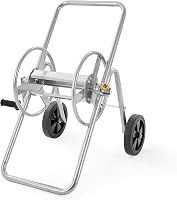
The VEVOR 250 Ft Hose Reel Cart holds up to 250 ft of 5/8 in hose, with the main hose sold separately. Its steel frame has a weather-resistant coating and brass fittings.
Choose it for a longer existing hose or a yard where one fixed storage point is awkward. The hand crank lets you wind the hose, while the basket keeps small watering accessories nearby.
Its 4 solid 10 in PU wheels avoid air-pressure checks. VEVOR describes them as suitable for uneven ground, but your route still needs enough width and clearance for the loaded cart.
Capacity is a ceiling, not a reason to buy the longest possible hose. Carrying extra hose adds bulk, and a very long run can reduce flow at the far end.
Skip this cart for a small enclosed patio or a route with frequent steps. It also won't suit someone whose main goal is avoiding manual winding.
Before setup, read how to put a hose on a hose reel cart. For more mobile options, compare the best hose reel carts.
How do hose diameter and length affect your choice?
Choose the shortest hose that comfortably reaches your work, with a diameter suited to the water flow you need. Extra length and a narrower bore both increase resistance as water travels through the hose.
A 1/2 in hose can suit hand watering where reach and handling matter more than a high flow rate. A 5/8 in hose is often a better starting point for longer runs or tasks that need more water.
Your faucet, supply pressure, nozzle and connectors also affect the result. A wider hose cannot correct a weak water supply, and a restrictive connector can limit an otherwise suitable setup.
For a sprinkler, check the sprinkler's own flow and pressure requirements. Choosing a reel by hose length alone can leave you with enough reach but poor coverage.
Pressure capacity is not the same as delivery pressure. A hose's pressure limit does not tell you how much water will arrive at the nozzle.
Compare the practical trade-offs in our 5/8 vs 1/2 hose reel guide.
Should you buy a hose reel with or without a hose?
Buy a hose-included reel when its hose already matches your route and watering tasks. Choose a hose-free reel when you have a suitable hose or want to select its material, length and diameter yourself.
For a retractable unit, hose fit affects how the mechanism winds and stores it. Do not assume you can replace the supplied hose with any garden hose of the same length.
For an open spool, check capacity against your exact hose type. Diameter matters, but wall thickness and stiffness can also change how neatly a hose fits.
Inspect an existing hose before buying storage for it. Flattened sections, cracked outer material or damaged end fittings deserve attention before you wind it onto a new reel.
Check the connection at the reel inlet and hose end too. Extra adapters create more joints, so use only what the setup needs.
Our guide to buying a hose reel with or without a hose explains that choice in more detail.
How should you set up a hose reel?
Set up a hose reel with secure support, relaxed connections and a clear pull path. Placement and hose routing matter as much as attaching the bracket or assembling the frame.
Position a fixed hose reel before drilling
Hold or mark the proposed position, then check the routes you measured earlier. Make sure the housing can turn and the hose can leave without rubbing across an edge.
Follow the unit's mounting height and clearance instructions. Choose a position where you can operate, inspect and remove the reel without reaching awkwardly.
Use support and fasteners suited to the wall or base. Supplied hardware is not a reason to skip checking the structure beneath siding or the condition of masonry.
For ground installation, identify buried utilities before driving anchors or drilling. Keep the base outside areas where tools or foot traffic could strike it.
Connect and load a manual hose reel
Shut off the faucet before attaching hoses. Check that flat hose washers are present and seated, then start threaded connections by hand to avoid cross-threading.
Straighten the main hose before winding it onto a manual spool. Feed it evenly from side to side without forcing tight bends near the connection.
Open the faucet slowly and check each joint for drips. If a connection leaks, shut off the supply and release pressure before correcting it.
For the Giraffe Tools ground reel, the brand advises a full initial pullout followed by a guided return if the hose is hard to pull after transport. Follow its instructions and any extension limit markings.
How should you use and care for a hose reel?
Keep the hose clear, loosely routed and guided during storage. Regular checks at the connections and careful winding prevent many problems that look like reel faults.
Guide a retractable hose reel during return
Pull the hose along an open path instead of dragging it through dense plants or around furniture legs. Stop and free a snag rather than pulling harder against the mount.
Use the lock and release method in the instructions. During rewind, walk the hose back under control and keep the nozzle from swinging into people, windows or the housing.
Slow rewind still needs supervision. Keep children and pets clear of the return path, and do not open a spring housing to adjust the mechanism yourself.
Wind a manual hose reel without trapping twists
Straighten major twists before cranking, and guide the hose across the spool as it winds. Stop if it bunches against one side instead of trying to force more turns.
Keep fingers clear of the moving spool and pinch points. Do not use a reel's crank to drag a snagged hose across the yard.
Close the faucet after watering and release trapped pressure through the nozzle. Leaving the nozzle shut with the faucet open keeps the hose and connections under pressure.
Check hose reel leaks and seasonal storage
Look for drips at the faucet, leader hose and rotating connection. A damaged washer and a worn swivel need different repairs, so find the exact source before replacing parts.
Our hose reel parts guide explains the components. For leaks where the spool turns, see why a hose reel leaks at the swivel.
Wipe away soil before storage and keep grit out of connectors. Inspect coatings and plastic parts for damage, and use only care products approved in the instructions.
Before freezing weather, disconnect, release pressure and drain the system as directed. A freeze-resistant housing does not make trapped water safe.
Follow any indoor storage requirement, and use our hose reel winterizing guide to plan seasonal care. A cover can reduce exposure, but it cannot replace draining.
Which hose reel buying mistakes should you avoid?
Avoid choosing by maximum length or storage style alone. The right reel must also fit your hose, water supply, installation point and daily routine.
- Buying too much hose: Extra reach adds winding, storage and flow demands without helping if you never use it.
- Confusing capacity with included hose: A cart's capacity describes what it can hold, not what arrives with it.
- Ignoring mounting work: A convenient wall position is useful only if the support and attachment method are suitable.
- Counting the leader as working reach: The faucet connection and main watering route serve different jobs.
- Expecting wheels to solve every route: Steps, soft ground and narrow passages can make cart movement difficult.
- Using rewind to clear snags: Free the hose first so the return mechanism isn't pulling against an obstacle.
- Treating outdoor materials as winter protection: Drain and store the reel according to its instructions.
Before ordering, picture one complete watering session. Check where you will connect, pull, stand, wind and store the hose, including the work needed when the season ends.
Which hose reel should you choose?
Choose the hose reel that passes all 3 checks: enough reach, suitable support and manageable storage. Eliminate any option that fails one of those checks before comparing extra features.
| Your situation | Choose | Skip it when |
|---|---|---|
| Frequent hand watering from a sound wall position | VEVOR 1/2 In 100 Ft Retractable Reel | You need a larger hose bore or cannot mount it securely |
| Automatic rewind from a lawn or concrete position | Giraffe Tools 92 Ft Ground Reel | The base would obstruct traffic or the hose route is too long |
| A long separate hose that needs movable storage | VEVOR 250 Ft Hose Reel Cart | Steps, limited parking or manual winding make it impractical |
| An existing compatible hose beside one faucet | Suncast Sidewinder 100 Ft Wall Reel | You want automatic rewind or need to move the reel |
If two styles fit, let your put-away routine decide. Choose automatic return when cranking is the chore you want to remove, or a manual spool when keeping your chosen hose matters more.
For a yard with several disconnected watering areas, consider separate fixed setups before committing to one very long hose. The simplest daily route may matter more than storing everything on one reel.
Once the type is clear, compare the best garden hose reels within that style. Keep your route measurements and installation limits beside you so the final choice fits the yard you actually water.
Frequently asked questions
What type of hose reel is best for home use?
Choose a hose reel by its location and winding method; a retractable model suits frequent watering from a fixed point, a manual wall reel suits an existing compatible hose, and a cart suits several watering areas. Check the full hose route before deciding which style fits your yard.
How do I choose the right hose reel size?
Measure the actual hose route from the proposed reel position to the farthest watering spot, including bends around beds and furniture; check the faucet connection separately. Match the reel's capacity to both hose length and diameter, and allow enough working slack to avoid pulling against the mount.
Should I buy a hose reel with a hose?
Buy a reel with a hose when the included length and diameter suit your watering route; choose a hose-free reel when you already have a suitable hose or want more choice over its size and material. For an enclosed retractable unit, confirm replacement hose options before buying.
Can I mount a hose reel on vinyl siding or brick?
Mount a hose reel only where the support and fasteners meet its installation instructions; vinyl siding alone cannot support the reel, while brick installation requires a suitable masonry attachment method. Check for hidden pipes and wiring before drilling, and ask an installer if you cannot identify a sound mounting point.
How should I store a hose reel in winter?
Shut off and disconnect the water supply, release pressure, and drain the hose and reel before freezing weather; follow the reel's storage instructions, including indoor storage when required. A weather-resistant housing or outdoor cover does not protect trapped water from freezing inside the hose, swivel or fittings.