How to Choose a Hose Reel: Type, Length and Hose Size
To choose a hose reel, match the reel type to your space, hose length to your watering route, and hose diameter to your tasks. Check the mounting surface, faucet connection and storage space before buying.
On this page (9 sections)
- How to choose a hose reel for your yard layout
- How much hose length do you actually need?
- Does hose diameter matter when choosing a reel?
- Should you buy a hose reel with or without a hose?
- What should you check before mounting a hose reel?
- How do you set up a hose reel without kinks or leaks?
- How should you use and care for a hose reel?
- Which hose reel buying mistakes should you avoid?
- How do you choose the right hose reel from these options?
Learning how to choose a hose reel starts with 3 checks: where it will sit, how far the hose must reach, and how much water your tasks need. Match those needs first, then compare winding features and storage.
The right reel lets you reach your plants without dragging excess hose through every bed. It also fits a location where you can put the hose away after each use.
For an overview of the main designs, see our guide to retractable, wall-mount and cart hose reels.
How to choose a hose reel for your yard layout
Choose a fixed reel for one watering zone and a cart when you need to move between areas. A secure mounting point and a clear hose route matter more than a long feature list.
Walk the route you normally take while watering. Note gates, steps, parked cars and corners where the hose catches, since these can make a fixed reel awkward even when its hose reaches.
| Reel type | Choose it for | Main trade-off |
|---|---|---|
| Retractable wall reel | Frequent watering from one fixed point | Needs secure support and controlled rewind |
| Manual wall reel | Fixed storage with hand winding | Needs room to crank and guide the hose |
| Hose reel cart | Moving a hose between watering zones | Takes up ground space and requires a usable wheel route |
| Reel box | Enclosed storage near ground level | Needs room for the housing and access to the handle |
“Wall-mounted” describes the location, while “retractable” describes the winding method. A wall reel can use either a manual crank or automatic rewind.
A reel box suits a patio where you want the hose enclosed without hanging a unit on the wall. Check how it stays steady while you pull out hose, especially if you plan to place it on a smooth surface.
Choosing a hose reel for daily watering
Choose automatic rewind if putting the hose away is the part of watering you want to simplify. Choose a manual reel if you prefer direct control over winding and don't mind using a crank.
A retractable reel still needs attention during return. Read how a retractable hose reel works to understand its lock, spring and hose guide before choosing that design.
For a simple manual setup, the Suncast Sidewinder has a resin body, an included leader hose and a detachable reel for off-season storage. It arrives assembled, though wall installation is still required.
Choose the Sidewinder if you already have a compatible hose and a permanent watering spot. Skip it if you want automatic return, need to move between faucets, or have a bulky hose whose fit you haven't confirmed.
A cart better suits separate front and back watering zones when there is a usable route between them. Compare hose reel carts and hose reel boxes if you are deciding between mobility and enclosed storage.
How much hose length do you actually need?
Choose enough hose to follow the real route to your farthest watering point, with slack for comfortable use. Measure from the proposed reel position rather than assuming the faucet is the starting point.
Lay a rope along the path the hose will take. Go around beds, buildings and furniture, then measure the rope instead of drawing a straight line across obstacles.
Allow enough slack to stand beside the farthest plant without pulling the hose tight. Don't count the spray's reach as a substitute for hose length, since you may need to water gently at the soil.
Measure the faucet-to-reel connection separately. A leader hose supplies the reel and generally does not add usable reach beyond the reel's outlet.
If your measured route is close to a reel's full hose length, choose a better mounting spot or a longer suitable setup. Working at the end of a taut hose makes direction changes harder and encourages pulling against the mount.
When the VEVOR 1/2 in retractable reel fits
The VEVOR 1/2 In 100 Ft Retractable Reel suits routine watering of pots and beds from a fixed wall position. Its any-length lock lets you stop at the section you need rather than pulling out the full hose.
It also has slow rewind and a 9-pattern spray nozzle. Choose it when your main jobs are watering through a nozzle and keeping the hose enclosed between uses.
Skip this model if you need a mobile reel or your main task calls for sustained flow through a larger hose. More spray patterns won't make up for a hose size that doesn't suit your equipment.
When the VEVOR 5/8 in retractable reel fits
Choose the VEVOR 5/8 In 100 Ft Retractable Reel when you want automatic rewind and a larger hose bore for the same route length. It combines any-length locking, slow return and a 9-pattern nozzle.
This is the stronger fit of the 2 wall-mounted VEVOR options for buyers who prioritize flow for longer watering sessions. Check your water supply and sprinkler requirements before expecting a diameter change to solve weak output.
Skip it if your route exceeds its reach or you need to move the reel between faucets. Its 31.8 lb weight also makes sound mounting support a key part of the decision.
Our guide to choosing a reel for a 100 ft hose covers capacity choices if that is the length your route requires.
Does hose diameter matter when choosing a reel?
Match both diameter and length to the reel's capacity, then choose the hose bore around your watering tasks. A thicker hose needs more spool space and generally holds more water at the same length.
With other conditions equal, a wider hose loses less pressure along its length. That makes 5/8 in a useful choice for longer runs or equipment that needs more flow.
A 1/2 in hose can suit pots, small beds and other nozzle watering where a high volume isn't the goal. A reel cannot increase the pressure or flow available from your faucet.
Check the hose's inside diameter separately from its connector size. A fitting measurement describes the connection, so it doesn't automatically tell you the bore of the hose attached to it.
For an existing hose, check its size and construction before buying storage. A thick-walled hose may fill a spool sooner than a thinner hose of the same nominal diameter.
Read our 5/8 in vs 1/2 in hose reel comparison if those are your final choices. Favor the size your watering tasks need over the largest size you can find.
When a high-capacity cart makes sense
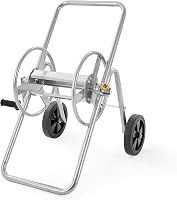
The VEVOR 250 Ft Hose Reel Cart suits buyers with a long compatible hose who need to reposition the reel. It has a powder-coated steel frame, brass fittings, manual winding and a storage basket.
Its 4 solid 10 in PU wheels make it an option to consider for a yard with a continuous rolling route. Walk that route first, since steps, deep gravel and soft ground can still make a loaded cart difficult to move.
Choose it if capacity and movement matter more than compact storage. Skip it for a small patio, automatic rewind, or a route that requires carrying the cart up steps.
You don't need to fill a cart to its maximum capacity. Use the length your route calls for so you aren't moving unnecessary hose and water.
Should you buy a hose reel with or without a hose?
Buy a reel with a hose when the included hose already fits your route and tasks. Buy an empty reel when you have a suitable hose or want more control over its length and construction.
An included hose removes one compatibility decision at setup. It can also tie your choice of reel to a hose size you wouldn't otherwise select.
Before choosing a retractable unit, check how hose replacement works and which parts are available. Don't assume you can fit any garden hose into a spring-driven housing.
For an empty reel, confirm capacity for your hose type, how the inner end attaches, and what connects the reel to the faucet. Include any needed leader hose and washers in your setup plan.
Our guide to buying a hose reel with or without a hose helps you decide whether to keep your current hose or start with a matched unit.
What should you check before mounting a hose reel?
Mount a reel only where the wall structure can support it and normal pulling forces. Leave space for its movement, hose exit and any crank handle.
A wall that looks convenient may have unsuitable support behind the surface. Follow the reel's instructions for the wall construction, mounting height and fasteners.
Don't rely on siding alone to carry the load. Read how to mount a hose reel on vinyl siding or brick before choosing hardware or drilling holes.
Hold a cardboard outline of the reel at the proposed position. Check door swings, walking space and access to the faucet, then picture the reel turning or your hand moving around the crank.
A swivel bracket helps the reel follow a changing pull direction, but it cannot route the hose through a wall or around a sharp corner. Position the unit so most pulling happens in open space.
Keep the leader hose free of tight bends and strain. Place it where it won't cross a walkway or get trapped behind the housing.
If a secure wall location isn't available, choose ground-level storage or a cart. A wall reel is the wrong choice if installing it properly requires a mounting arrangement you cannot provide.
How do you set up a hose reel without kinks or leaks?
Start with a straight hose, sound washers and a slack faucet connection. Follow the reel's connection and winding instructions before turning on the water.
For a manual reel or cart, lay the hose out to remove twists before attaching it. Wind in even layers and guide it across the spool instead of letting one side build into a mound.
Don't use the crank to drag a hose trapped under furniture or wrapped around a corner. Free the hose first so winding doesn't pull against the fitting or reel frame.
Check that coupling washers are seated and threads start straight. Tighten as directed, then open the faucet slowly and inspect the connections.
If a connection drips, shut off the water before adjusting it. Overtightening is a poor substitute for fixing a damaged washer or a crooked connection.
For a drip where the reel rotates, our guide to hose reel swivel leaks explains how to narrow down the source.
How should you use and care for a hose reel?
Guide the hose during rewind, relieve pressure after use and store it for your climate. These habits reduce avoidable strain on the hose, connections and reel.
On a retractable model, clear the route and walk the hose back at the pace described in the instructions. Keep hold of it rather than letting the nozzle race toward the housing.
Slow return is a useful feature, but it doesn't remove the need to control the hose. Keep children and pets away from its path while it retracts.
Pull out only the length you need, then engage the lock as directed. Avoid repeated hard yanks or forcing the hose once it reaches its extension limit.
On a manual reel, stop winding if resistance suddenly increases. Look for a kink, snag or uneven pile before applying more force.
After watering, close the faucet and release pressure through the nozzle before storing the hose. Brush off grit that could collect around guides, and inspect exposed hose for cuts or wear.
A frost-resistant housing does not protect trapped water from expanding when it freezes. Follow the reel's storage instructions and our hose reel winterizing guide before freezing weather.
Which hose reel buying mistakes should you avoid?
Avoid choosing by maximum capacity or convenience features alone. The reel must work with your route, hose, water supply and storage space.
- Measuring across obstacles: Trace the route around beds and corners so the hose reaches without being pulled tight.
- Ignoring hose construction: Match the capacity statement to your hose's diameter and type, especially with bulky hoses.
- Choosing extra length without a reason: Longer hose adds handling work and can reduce flow along the route.
- Treating included anchors as universal: Select the mounting method for the actual wall structure.
- Assuming a cart moves itself into position: Check gates, slopes, steps and its parking space before buying.
- Expecting rewind to clear snags: Free the hose before winding it in.
- Confusing a spray nozzle with a pressure washer: A concentrated stream changes the spray, but the reel doesn't create a separate powered water supply.
Also leave room to service the connections. A reel squeezed into a corner may fit on installation day but make washer changes and seasonal removal awkward.
How do you choose the right hose reel from these options?
To choose a hose reel, use your route and daily routine as the final filter. Eliminate any option that doesn't reach, fit its location or support the hose you need.
- Choose the VEVOR 1/2 in retractable reel for fixed-point nozzle watering when you want automatic storage and don't need the larger bore.
- Choose the VEVOR 5/8 in retractable reel when you want the same winding convenience and prioritize flow through a wider hose.
- Choose the VEVOR cart for a long compatible hose and watering zones connected by a usable rolling route.
- Choose the Suncast Sidewinder for manual wall storage when you already have a suitable hose and want seasonal removal.
Before ordering, write down your measured route, hose diameter, faucet-to-reel distance and available mounting or parking space. Use what size hose reel you need for the final capacity check, then choose the setup you'll find easiest to put away.
Frequently asked questions
How do I choose a hose reel?
Choose a hose reel by matching its type, hose capacity and mounting needs to your yard; measure the actual watering route, confirm your hose diameter, and check the faucet connection. Pick a cart for movement, a manual wall reel for hand winding, or a retractable model for automatic rewind.
What size hose reel do I need for a 100 ft hose?
Choose a reel rated to hold 100 ft of your hose's diameter and type; a capacity stated for a smaller or thinner hose does not confirm that yours will fit. Leave room for orderly winding, and check the separate leader hose connection before deciding where to install the reel.
Is a 1/2 in or 5/8 in hose better?
Choose 1/2 in for lighter watering duties and 5/8 in when flow matters more, especially over longer routes; with other conditions equal, the wider hose loses less pressure along its length. Your faucet supply, fittings and sprinkler needs still affect the result, so diameter alone cannot guarantee enough water.
Should I get a hose reel with or without a hose?
Buy a reel with a hose when its included length and diameter match your route and watering tasks; choose a reel without a hose when you want to keep a suitable hose you already own. Check capacity, connection parts and leader hose inclusion so you can plan the complete setup.
Where should I mount a hose reel?
Mount a hose reel on suitable structural support near the faucet, with room for winding or swiveling and a clear hose exit; follow its mounting instructions and select fasteners for the wall construction. Check that the hose route avoids doorways, sharp corners and places where people regularly walk.